

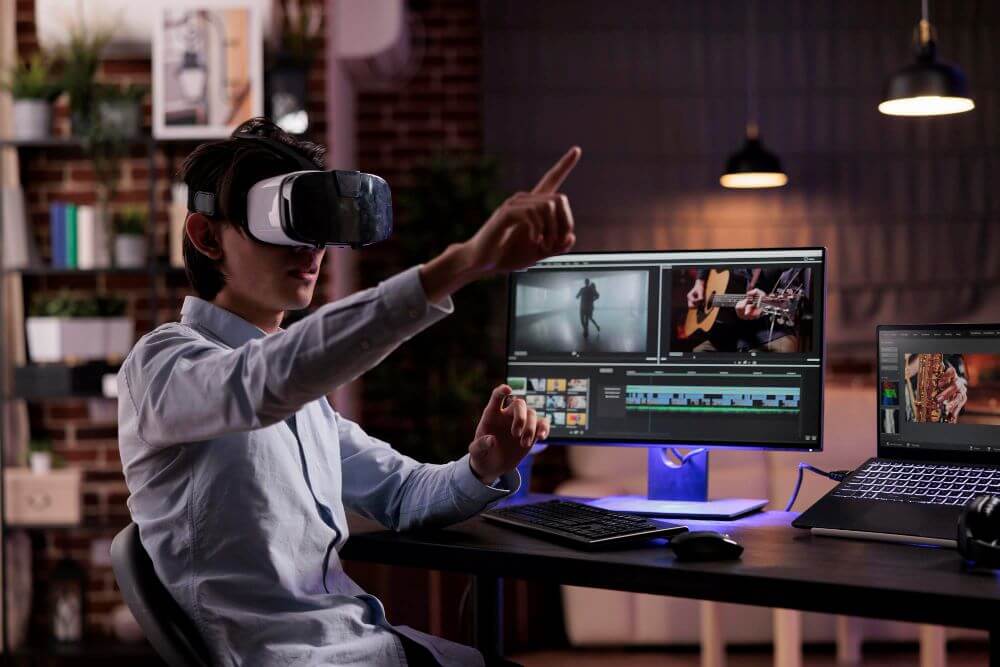
The landscape of content creation is shifting beneath our feet. Not long ago, editing a high-quality video required expensive hardware, years of technical training, and an almost infinite amount of patience. I remember sitting in front of a flickering monitor at 2:00 AM, my eyes bloodshot, just trying to cut out silences from a three-minute clip.
Today, things look a lot different.
Artificial intelligence has moved from a futuristic concept to a practical, everyday tool that is sitting right inside our editing suites. Honestly, it is a lot to take in. But have you ever stopped to wonder if we are losing the “art” in the process of chasing efficiency?
It is easy to feel a bit overwhelmed by the sheer speed of these changes. Every week, there seems to be a new tool promising to automate your workflow or generate professional visuals from a simple text prompt. But if we pull back the curtain, we see that these tools are not here to replace the storyteller. They are here to handle the heavy lifting so that we can focus on the soul of the story.
Why AI is Changing the Game for Creators
The most significant hurdle for any video creator is time. Traditional editing is a linear, often tedious process. And AI changes this by introducing non-linear, automated efficiencies. Think about the tasks that usually drain your energy. Transcribing audio, removing background noise, or resizing a horizontal video for social media platforms used to be manual chores. You know, the kind of work that makes you want to walk away from the computer entirely.
Now, these are one-click operations.
When you use AI tools for video editing, you’re essentially hiring a digital assistant. This assistant can scan hours of footage to find the best highlights or instantly remove a distracting object from the background of a shot. But does a faster workflow always mean a better story? Not necessarily. And that’s the point. This technology doesn’t just make the process faster; it makes it more accessible. Maybe, just maybe, the hum of the laptop at midnight won’t feel so lonely when the “boring” stuff is already done. People who never thought they could produce a polished video are now finding they have the power to share their vision with the world.
Essential AI Features You Should Know
To understand how to use these tools effectively, it helps to look at the specific problems they solve. Here are some of the most impactful features currently available in the modern editing ecosystem.
1. Automated Transcription and Text-Based Editing
This is perhaps the most life-changing feature for many editors. Instead of looking at waveforms and guessing where a sentence starts, AI can transcribe your entire video into text. You can then edit the video by simply editing the transcript. If you delete a sentence in the text, the software automatically cuts that section out of the video. It’s intuitive. It saves an incredible amount of time during the rough cut phase. I guess we’re finally moving past the era of scrubbing back and forth a thousand times.
2. Intelligent Audio Enhancement
We’ve all dealt with great footage ruined by poor audio. Maybe there’s a loud air conditioner in the background or wind hitting the microphone. Honestly, it is heartbreaking when a great take is lost to noise. AI audio tools can now isolate the human voice and strip away background noise with startling accuracy. They can even level out different speakers so the entire video sounds professional and consistent.
3. AI Video Translation and Dubbing
Breaking the language barrier has become a reality. An AI video translator can translate your speech into dozens of languages while maintaining your original voice and tone. Some of these tools even sync your lip movements to the new language. So, you can reach a global audience without the massive cost of traditional dubbing. It’s a massive leap for creators who want their message to resonate across borders. It feels a bit like living in the future, doesn’t it?
4. Generative Fill and Object Removal
In the past, removing an unwanted person or object from a shot required frame-by-frame masking. It was a specialist task. Now, generative AI can look at the surrounding pixels and “fill in” the gap left behind. It feels like magic. But it’s really just complex pattern recognition working in your favor.
5. Smart Reframing
If you film in widescreen but need to post on a vertical platform, you usually have to manually keyframe the movement. AI smart reframing tracks the action automatically. It identifies the most important part of the frame and keeps it front and center.
Balancing Technology and Human Intuition
With all these capabilities, there’s a temptation to let the machine do everything. However, the best videos still require a human heart. AI is excellent at technical execution, but it struggles with nuance. It doesn’t understand why a three-second pause after a specific word might bring a viewer to tears.
It lacks the gut feeling.
The goal is to find a middle ground. Use the technology to clear the path of technical obstacles, but keep your hands on the steering wheel when it comes to the creative direction. But are we ready to trust our intuition when the “perfect” AI suggestion is right in front of us? I’ve found that the best moments often come from the mistakes the AI would have “fixed.” The most successful creators are those who view AI as a sophisticated brush, not the artist itself.
The Future of the Edit Suite
We’re only at the beginning of this journey. As these models become more sophisticated, we’ll likely see even deeper integration. We might see tools that can suggest B-roll based on the context of your speech or tools that can automatically adjust the mood of your lighting to match the emotional tone of the music.
But even as AI tools evolve, the core mission in content creation remains the same. We want to connect. We want to share ideas. We want to move people. AI is simply providing us with a faster, more efficient way to get our messages across. It’s an exciting time to be a creator, provided we stay grounded in our own perspective and use these tools to amplify our unique voices. At the end of the day, it is still your story. You’re just getting a little help telling it.
