

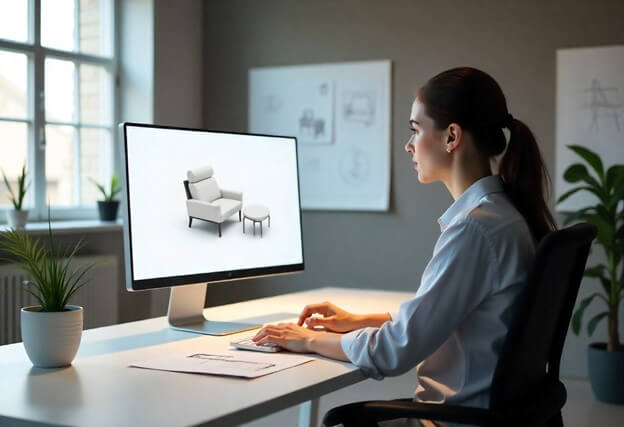
In today’s rapidly evolving digital landscape, businesses are under increasing pressure to deliver richer, more engaging customer experiences. One of the most powerful tools enabling this shift is 3d visualization, a technology that not only enhances the way products are presented online but also significantly boosts conversion rates by helping customers understand exactly what they’re buying.
By turning static images into dynamic, interactive models, 3d visualization empowers brands to communicate value with clarity and precision—something traditional product photography simply can’t match.
Why 3D Product Visualization Matters More Than Ever
Consumer expectations have changed dramatically over the past decade. Shoppers now demand transparency, detail, and control. This is especially true in sectors like furniture, electronics, fashion, automotive, and industrial manufacturing, where understanding scale, material, and functionality is essential before committing to a purchase.
3D product visualization bridges that gap by giving customers the ability to rotate, zoom, configure, and inspect items from every angle. Instead of relying on imagination or incomplete photos, the buyer experiences the product in a format that feels almost tangible.
This shift offers several key advantages:
- Enhanced Understanding:
Customers get a clear sense of proportions, features, and materials, reducing uncertainty and buyer hesitation. - Reduced Returns:
When people know precisely what they are getting, they are far less likely to send it back. Many brands that adopt 3d visualization report double-digit reductions in return rates. - Higher Engagement and Conversions:
Interactive visuals keep users on product pages longer and increase confidence, often leading to significantly improved sales metrics. - Cost Efficiency:
Creating 3D models replaces costly photoshoots, repetitive image generation, and logistical challenges, especially for products with multiple variations.
From Static to Interactive: The Experience Consumers Want
One of the most compelling aspects of modern 3D technology is its ability to personalize the customer journey. For example, an online furniture store can allow customers to switch upholstery fabrics, compare colors instantly, or view how a sofa’s modular components fit together—all from their browser.
This level of interactivity transforms the shopping process into an exploration, making it both fun and informative. Brands that embrace this approach are rewarded not only with increased conversions but with customer satisfaction that translates into long-term loyalty.
Some notable use cases include:
- Configurable Products:
Vehicles, equipment, and customizable gear benefit enormously from 3D interfaces that let buyers build their ideal version. - Architectural and Interior Previews:
Clients can virtually “walk through” spaces, examining layouts, lighting, and furnishings in high detail. - Fashion and Accessories:
Virtual try-on technology integrated with 3D modeling helps users see how items might look on them in real life. - Industrial and Engineering Applications:
Detailed 3D models help teams visualize components, streamline manufacturing, and communicate complex designs clearly.
The Role of Realism: Materials, Lighting, and Precision
High-quality 3D product visualization hinges on photorealism. The more realistic the model, the more persuasive the product. Material accuracy, texture fidelity, and lifelike lighting are no longer optional—they’re expected.
Modern rendering engines simulate:
- Natural light behavior and reflections
- Micro-details such as fabric weave, metal scratches, and wood grain
- Physics-accurate shadows and depth
- High-resolution textures that maintain clarity at any zoom level
This realism results in models that can rival or even surpass the effectiveness of traditional photography, especially when combined with immersive experiences like AR previews on mobile devices.
3D Visualization Beyond E-Commerce
While digital retail is a major beneficiary, the impact of 3d visualization extends far beyond online shopping. In sectors such as real estate, education, entertainment, healthcare, and aerospace, 3D technology is driving innovation at a remarkable pace.
- Real Estate: Virtual tours help buyers explore properties without geographical constraints.
- Medical Training: 3D anatomy models allow students to safely practice and visualize complex procedures.
- Gaming and Film: Hyper-realistic 3D environments form the backbone of modern entertainment.
- Manufacturing: Engineers use 3D modeling for prototyping, simulation, and quality control.
Its versatility makes 3d visualization one of the few technologies that is equally valuable to consumers, creators, educators, marketers, and engineers.
The Future: AI-Driven 3D and Real-Time Configurators
As AI and real-time rendering engines advance, we are moving closer to instantly generated 3D content, faster workflows, and even more interactive experiences. Soon, brands may be able to upload a single product blueprint and generate a complete 3D model library within minutes.
Emerging trends include:
- AI-assisted 3D modeling that reduces manual labor
- Real-time rendering in web browsers through WebGL and WebGPU
- Augmented reality commerce, letting customers place products in their own environment
- Digital twins for enterprise monitoring and predictive maintenance
- Virtual stores and showrooms that blend commerce with immersive storytelling
These innovations will push 3d visualization from a competitive advantage to an industry standard.
Conclusion
3d visualization is not just a technological upgrade—it is a fundamental enhancement to how products are communicated, understood, and experienced. In a world driven by digital impressions, giving customers the ability to interact with products in 3D builds trust, clarity, and emotional engagement.
Businesses that embrace this shift will stand out in crowded markets, reduce costs, and offer experiences that feel genuinely modern. Those who hesitate may find themselves outpaced by competitors who understand that in today’s digital age, visualization is no longer optional—it’s essential.
